
Introduction
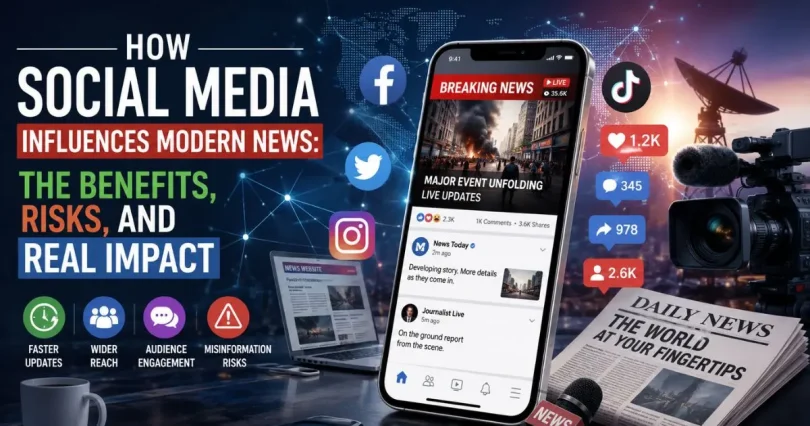
How Social Media Influences Modern News. Social media has changed the way people receive and interact with news. Instead of waiting for television broadcasts, newspapers, or news websites to report a story, people can now learn about major events within seconds through posts, videos, live streams, and shared updates.
Platforms such as Facebook, X, YouTube, Instagram, and TikTok have become important channels for discovering news. Journalists can publish updates instantly, news organizations can reach audiences directly, and ordinary people can share information from the scene of an event.
This has made modern news faster and more interactive. However, it has also created serious challenges. False information can spread quickly, algorithms can influence what people see, and viral content may sometimes receive more attention than accurate reporting.
Social media, therefore, does more than simply distribute the news. It influences which stories gain attention, how quickly information spreads, how audiences react, and how journalists report events.
Quick Key Takeaways
- Social media allows news to spread to large audiences almost instantly.
- People increasingly discover news through social platforms, videos, and shared posts.
- Journalists use social media for breaking news, audience engagement, and real-time reporting.
- Algorithms can influence which news stories users see most often.
- Social media gives ordinary citizens the ability to share information and eyewitness content.
- Misinformation and unverified news can spread just as quickly as accurate information.
- Social media has made news more accessible and interactive, but it has also created new challenges for trust and accuracy.
How Does Social Media Influence Modern News?
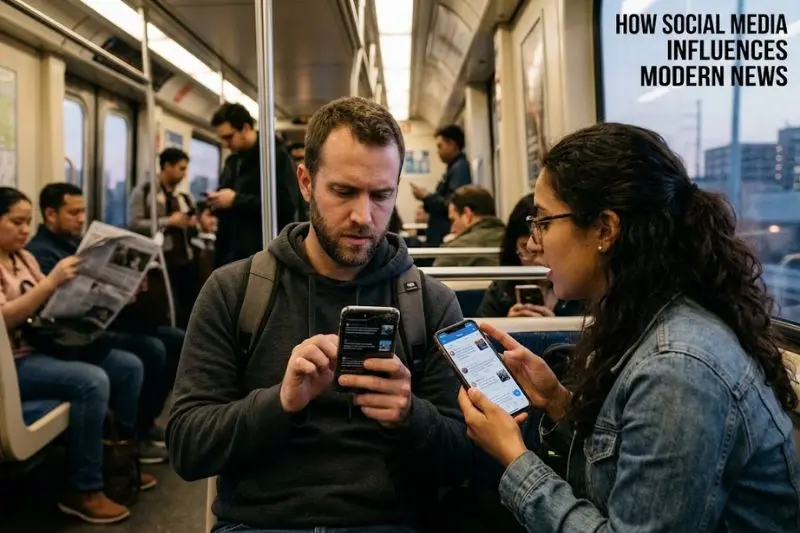
Social media influences modern news by changing how information is created, shared, discovered, and discussed. News can now reach millions of people within minutes, while audiences can actively comment on, share, and even contribute to the reporting of events.
Traditional news organizations once had much greater control over how stories reached the public. Today, a breaking event may first appear as a social media post, video, photograph, or live stream before it is covered by a major news organization.
Social platforms have also created a more interactive news environment. People are no longer only readers or viewers. They can respond to stories, share their opinions, provide eyewitness material, and participate in discussions as events develop.
At the same time, this speed creates risks. Information shared online may be incomplete, misleading, or completely false. For this reason, the influence of social media on modern news includes both major benefits and serious challenges.
Why Social Media Has Become an Important News Source
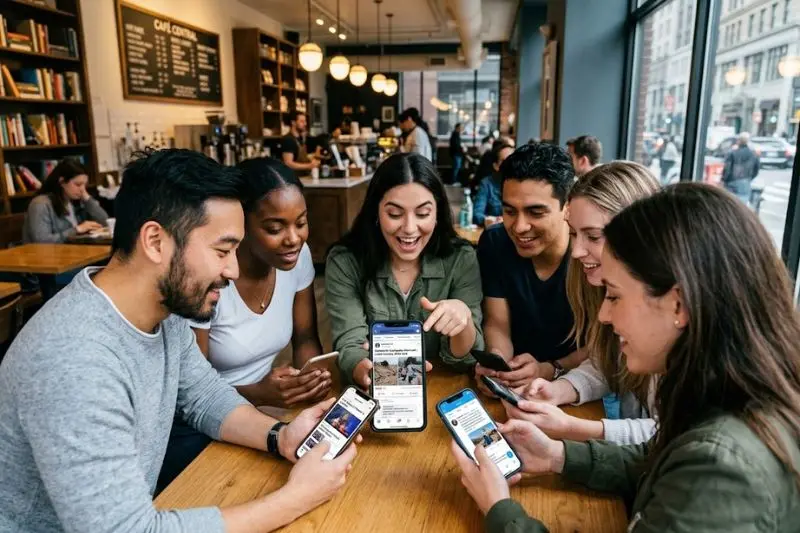
For many people, social media is now one of the first places they encounter breaking news. A person scrolling through a feed may discover information about politics, sports, business, entertainment, natural disasters, or international events without actively visiting a news website.
Several factors have contributed to this change:
- Instant access: News can be published and shared immediately.
- Easy sharing: Users can quickly send important stories to friends and followers.
- Mobile accessibility: News is available through smartphones at almost any time.
- Visual content: Videos, images, live streams, and short clips can make events easier to follow.
- Personalized feeds: Platforms recommend content based on user activity and interests.
- Direct communication: Journalists, organizations, experts, and public figures can communicate directly with audiences.
This transformation has made the modern news cycle faster than ever before. A story can develop, receive public reactions, and change several times within a single day.
How Social Media Has Changed the Way News Is Distributed
Social media has transformed news distribution from a mostly one-way system into a fast, interactive network.
In the traditional model, news organizations produced a story and distributed it through newspapers, television, radio, or their websites. Audiences mainly received the information. Today, a news story can move through multiple channels at once: a journalist may post an update, a news organization may publish a video, and thousands of users may share, comment on, and discuss the story within minutes.
This means that news distribution is no longer controlled only by traditional publishers. Social platforms have become major gateways through which people discover information.
Traditional News vs Social Media News Distribution
| Traditional News Model | Social Media News Model |
|---|---|
| Information is mainly published by news organizations | Information can be shared by journalists, organizations, creators, and users |
| Publication may follow scheduled editions or broadcasts | Updates can be published instantly |
| Audience mainly consumes information | Audience can comment, share, react, and contribute |
| Editorial teams largely control distribution | Platform algorithms and user sharing also influence reach |
| News moves through established media channels | News can spread across global networks within minutes |
| Corrections may reach audiences later | Updates and corrections can be published quickly, but false information may continue circulating |
The biggest change is speed combined with participation. Anyone with an internet connection can potentially become part of the news process.
Social Media Makes Breaking News Faster
One of the strongest influences of social media is the speed at which information travels.
When a major event occurs, people at the location may post photographs, videos, or eyewitness accounts before journalists arrive. News organizations can then monitor developments, verify available information, and provide broader context.
For example, during a major event:
- Someone records or witnesses what happens.
- Information is posted on social media.
- Other users begin sharing the content.
- Journalists and news organizations identify the developing story.
- Reporters verify facts and seek reliable sources.
- Professional news coverage provides additional context and updates.
This can help the public learn about important events quickly.
The problem with speed
Being first does not always mean being accurate.
Early information about a breaking event is often incomplete. Videos may lack context, old images may be presented as new, and initial reports can contain mistakes. This creates pressure on journalists and news organizations to balance speed with verification.
A responsible approach is not simply to repeat whatever is trending. It involves checking:
- Who originally posted the information?
- When and where was the content created?
- Is the image or video authentic?
- Can the claim be confirmed by reliable sources?
- Is important context missing?
This is one of the biggest differences between simply seeing information online and receiving verified news reporting.
Social Media Changes How People Discover News
Many people no longer begin their search for news by opening a newspaper homepage or watching a scheduled television bulletin.
Instead, news may appear while they are:
- Scrolling through a social feed
- Watching short-form videos
- Viewing posts from people they follow
- Seeing a trending topic
- Receiving a shared link from a friend
- Watching a live stream
- Following a journalist or news organization
This is known as incidental news exposure—people encounter news even when they were not actively searching for it.
Why this matters
Incidental exposure can introduce people to stories they might otherwise miss. However, it also means that the news a person sees may depend heavily on:
- Their social connections
- Accounts they follow
- Previous online activity
- Platform recommendations
- Trending content
- Engagement patterns
As a result, two people using the same platform may receive completely different views of what is happening in the world.
Algorithms Influence Which News Gets Attention
An important part of social media’s influence comes from algorithms.
An algorithm is a system used by a platform to help decide which content is shown, recommended, or given greater visibility to users.
Social media platforms do not usually display every possible piece of content equally. Instead, feeds and recommendation systems may prioritize material based on factors such as relevance, previous activity, engagement, and other platform-specific signals.
How this affects modern news
Algorithms can influence:
- Which stories appear prominently
- How often users see certain topics
- Which videos receive recommendations
- How quickly a story reaches a larger audience
- Which voices receive more visibility
This creates a major shift in the news ecosystem.
A journalist may consider a story important because of its public significance. A social media system, however, may give more visibility to content that generates stronger user engagement.
These priorities are not always the same.
The key issue
Public importance and online popularity are different things.
A story about an important policy change may receive less attention than a dramatic or emotionally charged video. This can affect what audiences believe is important simply because they see some stories repeatedly while rarely encountering others.
Social Media Gives Citizens a Role in News Reporting
Before social media became widespread, most people had limited opportunities to contribute directly to news coverage.
Today, ordinary citizens can document events using smartphones and publish information immediately.
This is often called citizen journalism or user-generated news content.
Examples of citizen contributions
People may share:
- Photos from an event
- Videos of breaking situations
- Eyewitness accounts
- Live updates
- Local information
- First-hand observations
This can be particularly valuable when professional journalists are not immediately present.
Benefits
- Citizen-generated content can:
- Provide early evidence of developing events
- Show perspectives from people directly affected
- Bring attention to local stories
- Help journalists identify breaking developments
- Expand the range of voices in public discussions
Risks
However, user-generated content must be treated carefully.
A person may:
- Misunderstand what they are seeing
- Share an unverified claim
- Post outdated content
- Accidentally provide false context
- Deliberately manipulate information
For this reason, citizen content can be an important source of information, but it is not automatically verified journalism.
Social Media Makes News More Interactive
Traditional news often followed a simple pattern: publishers created content, and audiences consumed it.
Social media changed this relationship.
Audiences can now:
- Comment on stories
- Ask journalists questions
- Share additional information
- Challenge claims
- Express opinions
- Discuss events with others
- Follow developing stories in real time
This interaction can make news feel more immediate and accessible.
Direct communication with journalists
Social media also allows journalists and news organizations to communicate directly with their audiences.
A reporter can explain a developing story, answer questions, provide updates, and correct information without waiting for the next newspaper edition or television broadcast.
This can strengthen transparency when used responsibly.
However, constant interaction also creates challenges. Journalists may face pressure from highly emotional online reactions, coordinated campaigns, harassment, or demands for immediate answers before all facts are available.
The Rise of Video-Based News Consumption
Social media has also changed the format of news.
Many users now encounter news through:
- Short videos
- Explainer clips
- Live streams
- Visual posts
- News summaries
- Creator-led analysis
This format can make complex topics easier to access, especially when visual evidence or demonstrations are useful.
For example, a short video can quickly explain:
What happened → Why it matters → Who is affected → What may happen next
The advantage
Visual formats can help audiences understand events quickly.
The limitation
Short content may leave out important context.
A 30-second clip may explain the basic event but fail to include:
- Historical background
- Different perspectives
- Evidence supporting a claim
- Important exceptions
- Uncertainty
- Long-term consequences
Therefore, short-form social news can be useful for discovery and quick updates, while longer reporting may be necessary for deeper understanding.
Misinformation Can Spread Alongside Real News
One of the biggest risks of social media is that accurate and inaccurate information can spread through the same systems.
A misleading post does not need to be published by a professional news organization to reach a large audience. If enough people share it, its visibility can grow rapidly.
Common forms of misinformation
Misinformation may include:
- False claims
- Misleading headlines
- Edited or manipulated images
- Videos shared with incorrect context
- Old content presented as new
- Fake accounts impersonating reliable sources
- AI-generated content presented as authentic
- Claims based on incomplete information
Why people share misinformation
People may share inaccurate content because:
- The information appears convincing
- The headline creates a strong emotional reaction
- They trust the person who shared it
- They do not check the original source
- The content confirms what they already believe
- The story spreads before verification is available
A practical example
Imagine a dramatic video begins trending with the caption:
“Breaking: This happened today.”
Before sharing it, important questions should include:
- Where did the video originally come from?
- When was it recorded?
- Can its location be confirmed?
- Is the caption accurate?
- Are reliable news organizations reporting the same event?
A viral post can be popular without being true.
Social Media Can Create Echo Chambers
An echo chamber is an environment where people are repeatedly exposed to similar opinions and information while encountering fewer opposing or alternative perspectives.
Social media can contribute to this when users mainly follow accounts that share their existing views.
Algorithms and user behavior may further reinforce these patterns by recommending similar content.
Possible effects
This may lead to:
- Greater political or social polarization
- Less exposure to different viewpoints
- Stronger confirmation bias
- Increased confidence in unchallenged beliefs
However, social media does not affect every user in exactly the same way. People actively choose accounts, communities, and sources, so both platform design and user behavior influence the information environment.
Social Media Has Changed the Business of Journalism
The influence of social media is not limited to how audiences consume news. It has also affected how news organizations operate.
News publishers must now consider:
- Social distribution
- Mobile audiences
- Video content
- Audience engagement
- Platform traffic
- Changing referral patterns
- Competition from independent creators
A news organization may produce a major article, but its audience could first encounter it through a short social post, video, or shared link.
This has encouraged publishers to adapt their reporting for multiple formats.
For example, one major story might become:
| Content Format | Purpose |
|---|---|
| Full article | Detailed reporting and context |
| Short social post | Quick update and discovery |
| Video | Visual explanation |
| Live coverage | Real-time developments |
| Infographic | Easy-to-understand information |
| Q&A | Answers to common audience questions |
Benefits of Social Media for Modern News
Social media has created several important opportunities for the news industry and the public.
Faster access to information
Audiences can learn about important events almost immediately.
Greater accessibility
People can access news from smartphones and other internet-connected devices.
Wider reach
A local story can potentially reach a national or international audience.
More diverse voices
Social platforms can provide space for independent journalists, experts, communities, and individuals who may receive less attention in traditional media.
Real-time updates
Developing stories can be updated as new information becomes available.
Greater audience participation
Readers and viewers can discuss stories and interact with journalists.
New storytelling formats
Videos, graphics, live streams, and interactive content can help explain complex events.
Drawbacks and Risks of Social Media News
The benefits come with significant challenges.
Misinformation
False or misleading information can spread rapidly.
Lack of context
Short posts and videos may oversimplify complex issues.
Algorithmic influence
Users may not have full control over which stories are prioritized in their feeds.
Pressure for speed
News organizations may face pressure to publish quickly before all facts are confirmed.
Echo chambers
Users may repeatedly encounter information that supports their existing beliefs.
Difficulty identifying reliable sources
Not every account that looks professional or authoritative is trustworthy.
Attention-driven content
Emotionally charged or sensational material may receive greater engagement than less dramatic but important reporting.
Expert Insight: The Real Change Is Not Just Speed
The most important change caused by social media is not simply that news travels faster.
Social media has changed who can participate in the news process and what determines the visibility of information.
In the past, editorial organizations had greater control over the journey from reporting to publication to audience. Today, that journey may involve:
Eyewitness → Social Post → User Sharing → Algorithmic Recommendations → Journalist Verification → News Coverage → Public Discussion
This creates a more open and immediate information environment, but it also makes verification, context, and media literacy more important.
For readers, one of the best habits is to use social media as a place to discover developing stories, then check important claims through credible reporting, original sources, and multiple reliable outlets.
Common Mistakes When Getting News From Social Media
Social media can be useful for discovering breaking stories, but readers often make mistakes that affect how accurately they understand an event.
1. Sharing Before Verifying
A post may look convincing and still be inaccurate. Before sharing an important claim, check the original source and look for confirmation from reliable reporting or official sources.
2. Trusting Viral Content Automatically
High engagement does not prove that information is true. A post can receive thousands of likes and shares because it is emotional, surprising, or controversial.
3. Reading Only the Headline or Caption
Headlines and captions often simplify a story. Read the full report and check the available evidence before forming a strong opinion.
4. Ignoring the Publication Date
Old videos, photographs, and articles are sometimes reshared as if they describe a current event. Always check when the original content was published or recorded.
5. Confusing Opinion With News Reporting
Commentary, analysis, and personal opinions can be valuable, but they should not automatically be treated as verified factual reporting.
6. Depending on Only One Source
Important stories can be complex. Comparing information from multiple credible sources can help readers identify missing context and conflicting claims.
7. Assuming a Verified Account Is Always Correct
An account may be authentic while still sharing incorrect, incomplete, or rapidly changing information. The source and evidence behind each individual claim still matter.
Myths vs Reality About Social Media and News
| Myth | Reality |
|---|---|
| Social media news is always unreliable | Social media can distribute reliable reporting, but users must evaluate the original source and evidence. |
| Viral content is probably true | Popularity measures attention, not accuracy. |
| Traditional news is no longer important | Professional reporting remains important for verification, investigation, context, and accountability. |
| Anyone can report news, so journalism no longer matters | Citizen content can provide valuable information, but professional journalism adds verification and editorial processes. |
| Social media algorithms show the most important news | Algorithms may prioritize content using multiple signals, and public importance is not necessarily the same as engagement. |
| A short video provides the complete story | Short-form content can explain an event quickly but may leave out essential context and complexity. |
| More information always means better-informed audiences | A large volume of information can also make it harder to identify reliable sources and accurate claims. |
How does social media affect modern news?
Social media affects modern news by making information faster to publish, easier to share, and more interactive. It also influences which stories people discover through user behavior, sharing, and platform recommendation systems.
What are the benefits of social media for news?
The main benefits include faster access to breaking information, wider distribution, real-time updates, audience participation, and opportunities for journalists and news organizations to communicate directly with the public.
What are the disadvantages of social media news?
Major disadvantages include misinformation, missing context, algorithmic influence, echo chambers, pressure to publish quickly, and difficulty identifying reliable sources.
How does social media spread misinformation?
Misinformation can spread when users share false or misleading content before checking it. Algorithms and recommendation systems can also increase the visibility of highly engaging content, regardless of whether every claim within it is accurate.
Can social media replace traditional news?
Social media can help people discover and follow news, but it does not fully replace the role of professional journalism. Investigative reporting, source verification, editorial standards, and detailed context remain important parts of the news ecosystem.
Why do people get their news from social media?
People use social media for news because it is convenient, fast, accessible on mobile devices, and integrated into platforms they already use. They can also receive updates from journalists, organizations, creators, and people within their own networks.
How can I tell whether news on social media is reliable?
Check who originally published the claim, review the date, look for evidence, and compare important information with credible and independent sources. Be especially careful with highly emotional posts, screenshots without sources, and videos presented without clear context.
Conclusion
Social media has permanently changed how modern news moves through society. Information can now travel from an eyewitness or journalist to a global audience within minutes, making news faster, more accessible, and more interactive than before.
However, speed and accessibility also create new risks. Misinformation can spread quickly, algorithms can shape what people see, and short-form content can remove important context from complex stories.
The best approach is not to treat social media as automatically good or bad for news. It is a powerful distribution and communication system whose impact depends on how platforms operate, how journalists use them, and how carefully audiences evaluate the information they receive.
Social media can be an excellent place to discover a developing story. For important claims, readers should go one step further: check the original source, seek reliable reporting, compare credible information, and avoid sharing claims before they have been properly verified.